Lab Methods
HPLC vs Mass Spectrometry: Which Peptide Test Do You Need?
By PRISM Analytical Laboratories · · 8 min read

Two instruments do most of the work in peptide analysis: High-Performance Liquid Chromatography (HPLC) and Mass Spectrometry (MS). Buyers often ask which one they need. The short answer is both, because each one answers a question the other cannot.
The quick answer
| Question | HPLC | Mass spectrometry |
|---|---|---|
| How pure is it? | Yes | No |
| How much peptide is in the vial? | Yes, with a reference standard | No |
| Is it the right compound? | Limited (retention time only) | Yes, via molecular weight |
| Can it spot by-products? | Yes, as extra peaks | Yes, as unexpected masses |
| Typical output | Chromatogram and % purity | Mass spectrum and observed MW |
How HPLC works
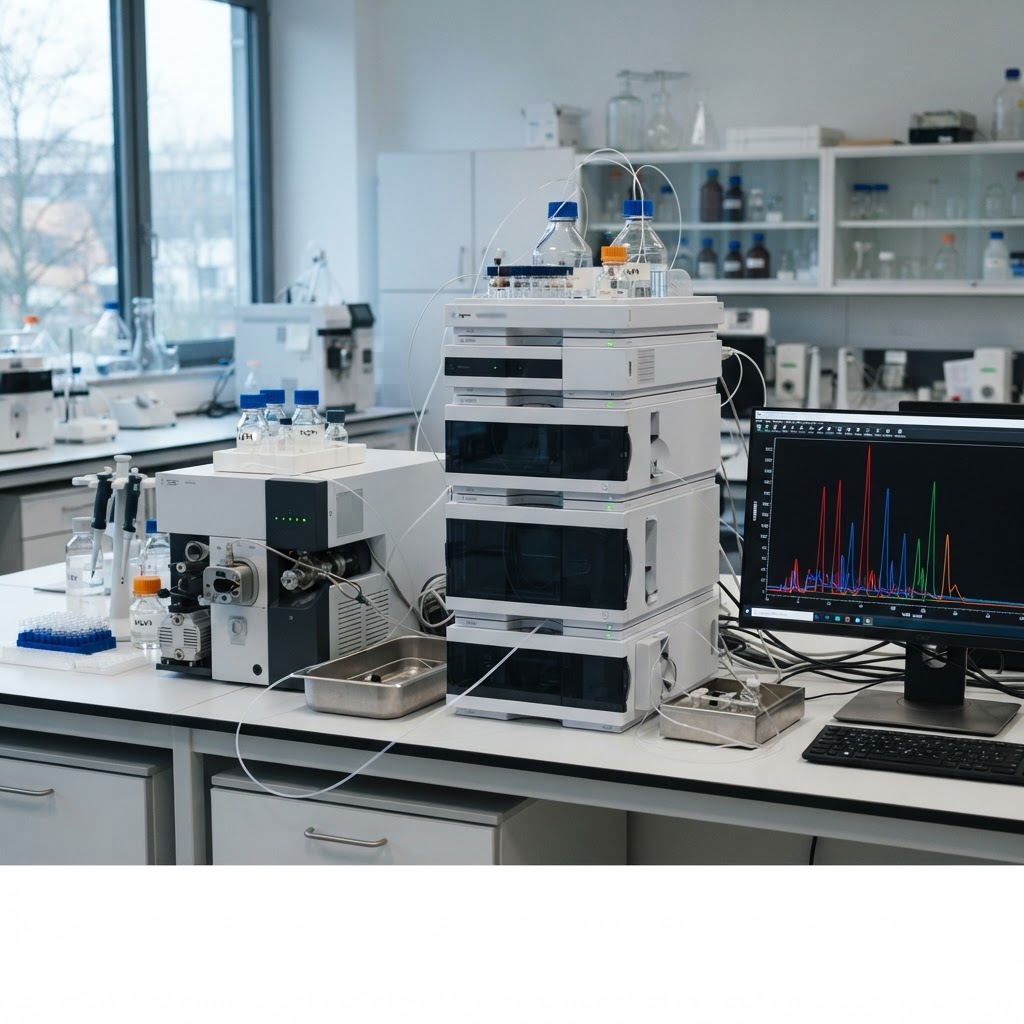
The sample is dissolved and pushed under high pressure through a column packed with fine particles. Different molecules interact with the column differently, so they come out (elute) at different times. A UV detector records each compound as a peak, and the time it appears is its retention time (RT).
- Purity = main peak area ÷ total peak area × 100
- Quantity = main peak area compared against a calibrated reference standard

Limits of HPLC on its own
HPLC can show one clean peak that is the wrong peptide. Two peptides of similar size and polarity can elute at nearly the same time. Without a mass confirmation, a perfect purity result does not prove identity.
How mass spectrometry works
MS ionises the molecules and measures their mass-to-charge ratio (m/z). From the spectrum, the lab calculates the observed molecular weight and compares it with the theoretical mass of the sequence.
| Peptide | Theoretical MW (approx.) |
|---|---|
| BPC-157 | 1,419.5 Da |
| TB-500 (Thymosin β4 fragment) | 889.0 Da |
| Semaglutide | 4,113.6 Da |
| Tirzepatide | 4,813.5 Da |
| Ipamorelin | 711.9 Da |
Limits of MS on its own
MS confirms what is present, but on its own it does not reliably tell you how much there is or what percentage of the sample is the target compound.
Why the best labs combine both (LC-MS)
When HPLC and MS run together, you get all three answers from one sample: what it is, how much there is, and how clean it is. This is the standard approach for any serious peptide COA.
Which test should you order?
| Your situation | Recommended analysis |
|---|---|
| One known peptide, checking a supplier | Single peptide analysis |
| Multi-peptide blend (e.g. BPC-157 + TB-500) | Blend analysis |
| Injectable research material | Add endotoxin screening |
| Concern about raw material quality | Add heavy metals screening |
Every PRISM peptide analysis combines HPLC with mass confirmation. Learn how to read the results, or configure a test now.